
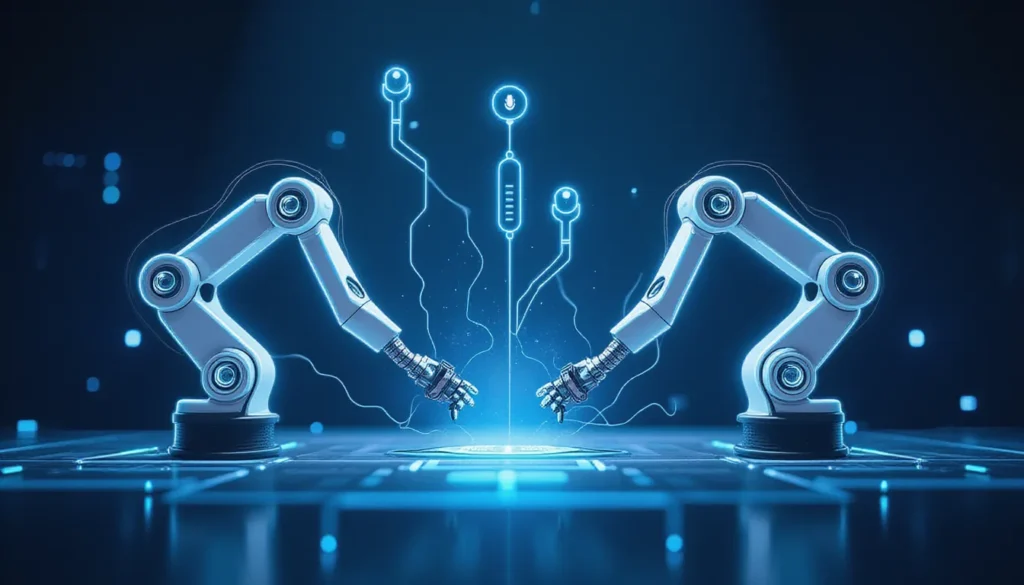
- 🤖 LeRobot Dataset v3.0 is the largest open robot learning dataset. This helps more people train good models.
- 🧠 VLA (Visuo-Language-Action) policies make robots better at understanding and acting on what they see and hear.
- ⚙️ The LeRobot plugin system lets you easily connect real hardware, making deployment simpler.
- 🧪 LeRobot and Isaac Sim use accurate simulations. This greatly reduces the need for risky robot training in the real world.
- 🔬 Open-source robotics helps many real-world areas, like healthcare, logistics, and smart homes.
Robotics, Now Within Reach
For many years, robotics was only for top research centers and big tech companies. But things have changed. Open-source robotics platforms, like LeRobot v0.4.0, and new resources, such as Dataset v3.0, mean building and using robot systems is now possible for more people. You can be an AI professional, a hobbyist working in simulation, or a no-code business owner using platforms like Bot-Engine. The way to hands-on robot learning has never been clearer.
Open-Source Robotics and the LeRobot Framework
Open-source robotics aims to break down barriers from private code, hidden data, and costly hardware setups. LeRobot is a good example of this idea. It was built to be modular, expandable, and community-focused. This means LeRobot is making it easier for many people to try out and use robots.
Key Features of the LeRobot Framework
- Modularity: LeRobot parts can be swapped, reused, or added to for different agents, tasks, and hardware types.
- Unified Simulation Environment: It gives you one place to build and test things across many simulation programs.
- Comprehensive Dataset Integration: It easily uses big datasets like v3.0 to train models in real-world conditions.
- Community-Driven Development: People worldwide help with its code and tools. This makes new ideas happen faster.
Private platforms often tie users to specific systems or ways to connect. But LeRobot helps you have freedom and work with different tools. You can train learning agents or make robots act right away based on voice commands. The framework gives you the tools to do this.
Why LeRobot Dataset v3.0 Changes Everything
For robot learning, data is key. It is the basis for how well robots perform. Dataset v3.0 by LeRobot changes what is possible. It combines size, quality, and easy access in ways that used to only happen with private datasets at big tech companies.
"LeRobotDataset v3.0 is the largest open robot learning dataset yet created."
The Power Behind Dataset v3.0
- Volume Meets Variety: Tens of thousands of task examples, both computer-made and real-world, cover many actions and situations.
- Multimodal Inputs: The data includes RGB vision, depth data, touch sensors, and robot joint positions (proprioception). This creates a rich space for models to learn.
- Standardization: It is made in formats that work everywhere. This helps people reuse it across different platforms and learning methods.
- Clean Annotations: Object labels, task results, timestamps, and environmental facts are clearly set up. This helps with both supervised and unsupervised learning.
In robot learning, random or messy datasets can cause robots to act strangely and not adapt well. What makes Dataset v3.0 special is the care put into making it consistent and well-labeled. This is important for training strong agents that can use what they learn in simulations for the real world.
Simulation Before Reality: Training Smarter Robots
One of the most expensive parts of robot development is testing. Every move a real robot makes uses energy, risks damage, and might bring up safety worries. LeRobot helps with these problems. It works closely with simulation platforms like NVIDIA Isaac Sim. This is a top 3D robotics simulator made to be realistic and handle many tasks.
“Training agents in very realistic simulation environments greatly cuts down the cost of real-world testing.”
— NVIDIA Developer Blog
Benefits of Simulation-First Training
- Rapid Iteration: Simulation environments let you do thousands of trial-and-error tests each day.
- Scenario Randomization: You can change lighting, obstacles, object spots, and physical settings at random. This helps robots adapt better.
- Zero-Risk Testing: Physical crashes, mistakes, or failures cost nothing and are easy to fix.
- Lower Barrier to Entry: Simulated robots do not need expensive building or hardware setup.
Designing robots with simulation first, often called “sim-to-real,” is not just handy. It is becoming standard practice. By training agents in a virtual world and then using them in the real world, teams can shorten development times. And they can cut operating costs without making models less reliable.
VLA Policies: Multimodal Learning for Better Decisions
In AI, context is very important. A robot in a kitchen with a general command like “grab it” will only work well if it can put together visual, language, and physical facts. That is what Visuo-Language-Action (VLA) policies promise. This is a new step in AI for robots that move and act.
What are VLA Policies?
VLA policies combine three main types of input:
- Vision: Objects and surrounding space seen by cameras or lidar.
- Language: Everyday instructions from people, either typed or spoken.
- Action: Figuring out tasks and planning movements to do desired behaviors.
A real example might be asking a robot, "Pick up the red mug behind the laptop and place it on the coaster." The robot would then understand the command, see the objects, and do the right movements.
LeRobot’s strong data formats and training steps let developers make and fine-tune these multi-modal policies. This happens without needing huge computing power. These VLA steps are inspired by basic models in natural language processing and vision. They bring large transformer systems and their great understanding skills into robot decision-making.
Plugins = Real-World Robot Access Without Friction
While simulation is key to scalable robot learning, doing things physically is the last step. That is why LeRobot v0.4.0 added a full plugin setup. This is a clear win for developers and system builders.
Plugin Advantages
- Abstracted APIs: Write Python scripts or use REST APIs without needing to know low-level device details.
- Multibrand Compatibility: It works with hardware from companies like Franka Emika, UR, Robotis, and others.
- Real-Time Control: Send commands and get sensor data live for quick feedback loops.
- Cloud/Nocode Integration: Direct links for platforms like Bot-Engine and automation hubs let robotics connect to bigger workflows.
Plugins get rid of many problems that make robotics hard to access. This is especially true for startups, teachers, and hobbyists. Before plugins, writing device drivers or custom ROS wrappers took weeks. Now, most connections can be set up in hours.
Training, Evaluation, and Scaling Made Simple
What makes LeRobot stand out is not just its open code. It also focuses on the whole development cycle. From making algorithms to testing in the real world, every part is handled in a modular and clear way.
Key Components for Developers
- Ready-to-Use Algorithms: It includes templates for common methods like behavior cloning, diffusion policies, and offline RL.
- Performance Tracking: Built-in logging with TensorBoard/OpenTelemetry helps with model tuning and finding bugs.
- Distributed Training Compatibility: It works with many GPUs/TPUs using PyTorch Lightning and Hugging Face Accelerate.
- Benchmarking Workflows: Pre-loaded scripts let you compare model checkpoints under the same conditions.
LeRobot combines easy-to-use datasets, clean simulation environments, and strong experiment steps. This changes it from a learning platform into something much closer to a production-ready MLOps framework, but for robotics.
Healthcare & Other Use Cases: From Simulation to Reality
Maybe the most important part of modern robot learning is not the technology itself. It is how it applies to everyday and high-stakes areas. Healthcare robotics already shows what platforms like LeRobot can do.
“A robot for surgery was trained completely in simulation before it worked well in the real world.”
— NVIDIA Developer Blog
Notable Use Cases Powered by LeRobot
- Surgical Robotics: Small operations can be tested in simulation and adjusted for different patients.
- Elder Care Assistants: Robots that help with daily tasks must learn safe and adaptable movement in homes.
- Warehouse Picking: Logistics robots trained with LeRobot can learn general picking actions that work for many stores.
- Rehabilitation and Physical Therapy: Personalized robot movement plans guided by sensor feedback and pre-trained models.
- Agricultural Robots: Checking crops and moving objects (like harvesting) needs simulation first. This helps avoid damaging plants.
What is common across these areas is not just new ideas. It is also the ability to grow. Simulation-first design, plugin-based use, and modular learning systems now let smaller teams build real-world robot uses without needing top resources.
Why Bot-Engine Users Should Care
If you are building automations without writing code, using tools like Bot-Engine, LeRobot adds a new level to your work: physical interaction.
Capabilities Enabled for Bot-Engine Users
- Pre-trained Models: Easily use smart robot policies without training them from scratch.
- Easy Simulation Access: Test how robots would act before putting them into real actions.
- Real-World Execution: Use plugins to send commands to robots through cloud APIs / event triggers.
- Hybrid AI Workflows: Mix AI conversations with robot movement, camera feeds, and object handling.
Imagine a warehouse chatbot that not only tells you where a product is, but also sends a robot to get it. You might work in e-commerce, industrial automation, or smart home services. Bot-Engine and LeRobot let this kind of AI-robot teamwork happen now.
Curious? Start Learning with the Open Robot Learning Course
Don’t know where to start? The Open Robot Learning Course on Hugging Face is a course for beginners to intermediate learners. It helps you get into this area.
What You’ll Learn
- Understanding Dataset Structures: How to read multimodal robot learning inputs, such as vision + touch + joint state.
- Training Your First Models: Set up an environment, run imitation learning, or try reinforcement methods.
- Simulation Tools: Step-by-step use of Isaac Sim and how to connect it with training scripts.
- Hands-On Exercises: Make your own virtual agent and teach it to do common or custom actions.
This course includes theory, code, and examples. It is the fastest way to start open-source robotics development.
So… Is Open-Source Robotics Finally Ready?
The short answer is yes. Here is why:
- 📦 Dataset v3.0 fills a big need. It gives the largest, cleanest open robot dataset for training.
- 🔌 Plugin-based hardware connections solve the last challenge of moving from simulation to real use.
- 🤝 LeRobot’s modular code smartly meets the needs of schools, startups, and automation platforms.
- 🌀 VLA policies bring new capabilities to even basic robot setups. This makes them smarter and more adaptable.
- 🌍 Many uses, from surgery to supply chains, show that open-source robotics is useful, real, and moving fast.
No PhD? No problem. The open-source robotics toolkit helps everyone.
Robotics For Everyone — Really
The future is not about separate advances, but about systems that work together. Tools like LeRobot and platforms like Bot-Engine are making connections. These connections let anyone, from teachers and startups to healthcare providers and logistics firms, use smart robots on a large scale.
You might want to automate a business task, make patient outcomes better, or just learn about the newest AI ideas. Open-source robotics is ready for you. Join the movement and bring robots to life for your needs.
Interested in mixing no-code automation with AI robotics? Let’s talk.
References
NVIDIA. (2023). Accelerating Robotics AI in Healthcare with Isaac Sim. Retrieved from https://developer.nvidia.com/blog
OpenAI. (2022). Scaling Laws for Robot Learning. Retrieved from https://openai.com/research
Stanford AI Lab. (2021). Foundation Models for Robotics. Retrieved from https://crfm.stanford.edu
Brown, T., et al. (2020). Language Models are Few-Shot Learners. In NeurIPS.