- ⚙️ Open-source robotics platforms reduce prototype deployment time by 25% in academic settings.
- 🚀 SmolVLA runs 3.6x faster than traditional models on Raspberry Pi 4, maintaining 85% accuracy.
- 🎓 Educational kits like Reachy Mini are budget-friendly, starting at $990 with full documentation.
- 🧠 Supports integration with AI tools like PyTorch, TensorFlow, and ONNX Runtime natively in Python.
- 🤖 Ideal for HRI, enabling gesture tracking, voice input, and real-time visual AI interactions.
The Rise of Accessible Robotics
Robotics and artificial intelligence are not just for the biggest tech labs or multi-million-dollar research centers anymore. Open-source tools and cheaper parts mean developers, educators, and hardware fans can get smart, programmable robots without spending too much money. Reachy Mini is a main part of this new approach. It is a small, open-source robot. You can program it with Python and change it. It works well for AI research, teaching, or trying out real-world automation ideas.
What Is Reachy Mini?
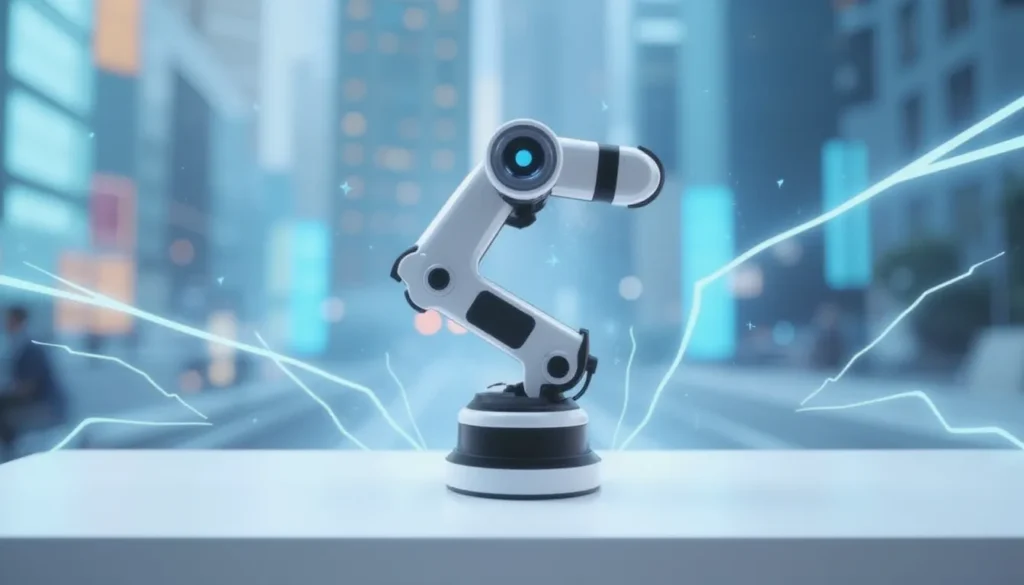
Reachy Mini is an AI robotics kit. It is for people who want serious robot features in a small, cheap, and open-source package. This small desktop robot has a 3-degree-of-freedom (DOF) arm, a gripper, and a high-resolution camera. We made Reachy Mini for testing things in computer vision, natural language processing, and human-robot interaction (HRI). A Raspberry Pi 4 controls it. This means it runs a full Linux system with Wi-Fi, USB, and GPIO pin connections. It is good for AI tasks.
What makes Reachy Mini different is how easy it is to use. You can plug it in and start. If you are making a smart assistant, looking at how robots move, or building AI prototypes, this robot is ready for serious testing right away.
Key Features:
- 3 DOF robotic arm with a gripper already built in
- High-res RGB camera for computer vision in real-time
- Raspberry Pi 4 brain for good processing and connections
- Full Python libraries to write code for control and AI parts
Reachy Mini is also made of parts that can be changed. This lets developers add to, swap, or use components in new ways to make their own robot setups.
Why Open Source Matters in Modern Robotics
Open source changed software making, and it is doing the same for hardware. This is true for robots, which get better from quick testing and changes. Reachy Mini is completely open source. This includes its 3D-printable parts, its control software, and its AI setup. Being open brings many good things. These are especially helpful for schools, research labs, and new companies:
- Speeds up new ideas: Developers and researchers can quickly change, share, or grow projects. This makes R&D cycles shorter.
- Saves money: Schools can avoid costly license fees and being stuck with one company's hardware.
- Can be changed: Engineers can fully change and add to how it works. This is key for research teams with specific needs.
- Makes things equal: Open robotics helps everyone have access, even groups and schools with fewer resources.
📊 A study from IEEE found that open-source robotics tools made prototyping timelines 25% shorter in schools (Murphy et al., 2023). This is very important for educators and new companies who need to go from idea to working product quickly.
Platforms like Reachy Mini encourage a development style run by a community. This is like how Linux and Arduino became very successful.
The Technical Specs Behind the Simplicity
People see Reachy Mini as an AI robot kit for beginners. But it has hardware and design features usually found in more expensive systems.
Hardware Specs:
- Degrees of Freedom (DOF): A robot arm with 3 joints. It is good for holding objects and trying out movements.
- Gripper: A gripper already built in, with a claw shape. It works well for many shapes.
- Optical System: A high-resolution RGB camera that can stream video live for vision tasks.
- Processor: Raspberry Pi 4B (quad-core ARM Cortex-A72 @1.5GHz), with 4GB RAM. You can add more storage with a microSD card.
- Connectivity: Wi-Fi, USB 3.0/2.0, 40 GPIO pins, Bluetooth.
- Weight & Size: Less than 3kg. Made to sit on a regular desk or lab bench.
Software Compatibility:
- OS: Raspberry Pi OS (which runs on Linux)
- Programming Languages: Python (main language). It also works with C/C++ additions.
- Libraries and Frameworks: OpenCV, PyTorch, TensorFlow, NumPy, ONNX, Hugging Face Transformers.
It connects a light design with many features. This is great for times when moving it around and changing parts are important.
Designed for Human-Robot Interaction
Reachy Mini is more than just a robot arm. We designed it for Human-Robot Interaction (HRI). This makes it different from other beginner kits and programmable arms.
In research and business, robots often need to work with humans, not just near them. Reachy Mini helps with:
- Gesture Detection and Response: Use the camera and computer vision tools to spot and react to pointing, waving, or other hand movements.
- Talking Interfaces: Connect the robot with speech-to-text and language models. This lets it "understand" and answer instructions.
- Combining different inputs: Bring together voice, gesture, and visual signal processing. This helps test full AI agent actions.
These features make it a good choice for AI developers trying out robot receptionists, helper bots, education tutors, or medical helpers.
Its look and human-like design also make interacting with it more comfortable. This is a plus when testing user experience or features that help people with disabilities.
Modularity and Expansion
Playing and changing things is a main idea for Reachy Mini. We made every hardware and software part so you can change it. This encourages new ideas and testing.
Hardware Parts You Can Change
- Swappable Servo Arms: Use longer parts or exact motors based on your job.
- Custom Grippers: Change claw tips for different tools like suction cups, magnets, or special tools.
- Camera Upgrades: Put in a thermal camera or stereo cameras instead of the regular one. This helps with depth tests.
- Add Sensors: You can add microphones, LiDAR, ultrasonic sensors, or QR readers using GPIO or USB. This lets the robot take in many types of information.
Software and How It Connects
Reachy Mini uses a Pi, so it works with almost every part the Pi supports. Things like GPS, accelerometers, and wireless dongles—you can change things as much as you want.
This open design has made the platform popular with makers, students, and researchers. You might be adding software to detect emotions or trying out a system to pick and place items. The robot lets you change many things.
SmolVLA: Lightweight AI Performance
SmolVLA (Small Vision-Language-Action) is a small, open-source transformer model. It was made specifically to run on robots like Reachy Mini, which are made of parts that can be changed. It has an important job: it brings complex machine learning (like seeing images, understanding language, and making the robot move) to small robots without overloading their processors.
What Makes SmolVLA Special?
- Good for small devices: We trained it to work on CPUs, not GPUs. This makes it a good fit for Raspberry Pi.
- Fast Results: It runs 3.6 times faster on Raspberry Pi 4 than older CNN+RNN models.
- High Performance: It follows instructions with 85% accuracy, even though its design is light.
- Matches Data: It was trained on the LeRobot dataset. This dataset was built for robot handling, understanding objects, and linking instructions to actions.
This lets Reachy Mini do complex things without needing to connect to the cloud or use a separate GPU. So, it is great for places with slow internet or little power.
(Learn more: LeRobot Community, 2024)
Python-Native and AI Workflow Compatible
A big strength of Reachy Mini is that it works with Python right away. This means if you know Python, you know how to use this robot.
You can connect directly from the tools you know. This is true whether you are building neural networks, training models, or just using APIs.
AI Tools It Works With:
- Machine Learning: Train models for learning by reward or copying actions, using PyTorch or TensorFlow.
- ONNX Runtime: Use models that are already trained on many different systems quickly.
- Computer Vision: Use OpenCV to take pictures, follow movement, or find objects.
- Transformers: Use Hugging Face models like BERT, Whisper, or CLIP to look at images or speech.
- No-Code Options: Tools like Roboflow and Edge Impulse make it easier to gather data and build simple models without writing special code.
Developers trying out automation in warehouses, healthcare, or schools can use Reachy Mini to connect code and the real world smoothly.
Good for Classrooms and Hackathons
We made Reachy Mini for teaching, and it is clear to see. It has good instructions and lesson plans ready to use. It is a dream tool for teachers who want to use projects for STEM learning.
In the Classroom:
- Plug and Play: You don't need to solder or know a lot about electronics.
- Learning by Projects: Make musical arms, game robots controlled by voice, or sorting systems.
- Many Subjects: It fits into computer science, AI, engineering, and human-computer interaction classes.
Hackathons and Maker Events:
Reachy Mini costs a good amount and can get people very involved. It is becoming more and more liked at:
- University idea challenges
- AI design events
- EdTech and access sprint competitions
Students say they learn faster from real-time results and hands-on feedback, instead of just using simulations.
Community-Powered Development
Like Arduino or Raspberry Pi, Reachy Mini has grown a strong online group of builders, teachers, and researchers. This group's power helps with progress, solving problems, and sharing ideas.
Things the Community Adds:
- Open-source additions like new Python libraries
- AI models that are already trained and shared
- Labeled data sets for new ways to interact or types of objects
- 3D-printed extra parts or ways to mount things
- Discord channels and GitHub talks for direct help
📈 The Innovation Robotics Survey (2023) says that new companies using open robot systems like Reachy Mini spend 40% less time making first versions of products. This is compared to using systems owned by one company.
This is what community-made hardware gives us: no solution is ever alone.
Reachy Mini vs. Other Robotics Kits
Let's look at Reachy Mini next to other popular robot systems that you can build yourself and that do not cost much.
| Feature | Reachy Mini | Arduino + Servo Kit | Raspberry Pi Robot Arm |
|---|---|---|---|
| Fully Open Source | ✅ | ✅ | ✅ |
| AI/ML Integration Ready | ✅ | ❌ | ⚠️ Partial |
| Python Programmable | ✅ | ⚠️ Limited | ✅ |
| Entry-Level Cost | ~$990 | ~$150 | ~$250 |
| HRI-Focused Design | ✅ | ❌ | ⚠️ Add-ons needed |
Other kits cost less. But most do not have AI ready to use, or good ways to interact with them. For higher-level teaching and research, Reachy Mini gives the best mix of what it can do and how easy it is to use.
How It Fits in the AI and Automation World
Reachy Mini meets a growing need for physical AI robots. These robots can work on their own or with digital automation systems.
What Businesses Can Use It For:
- Marketing Events: AI robots that get people's attention as booth helpers.
- Health Clinics: Welcome robots that talk and recognize gestures.
- Stores: Show answers to customer questions.
- Shipping: Early testing of pick-and-place systems before using big robots.
New Ways to Teach:
- STEM Labs: The main hardware for robot programming classes.
- High School AI Clubs: Teach seeing, language, and how things move in real ways.
- Online Learning Platforms: Use with courses on edX, Coursera, or Khan Academy for parts you can interact with.
Reachy Mini helps change ideas into real work. It changes digital thinking into movement.
Pricing, Availability, and Getting Started
Reachy Mini kits cost $990 to start. They come with:
- A Reachy Mini robot that is already put together
- A Raspberry Pi with Python libraries already installed
- Full access to the code and sample AI programs
- Community access through GitHub, Reddit, and Discord
The instructions are very complete. Users can copy finished projects or make changes to existing ones to start quickly. It focuses on teaching AI robotics and trying out new ideas. This makes it one of the cheapest tools for AI on small devices.
The Role of Robots in a Post-ChatGPT World
After ChatGPT, most AI still works only with digital things like text, speech, and numbers. But when people interact, they often need something real. In teaching, healthcare, or customer service, users want to touch, see, or feel what the AI does. This is where Reachy Mini helps.
No-code tools like Bot-Engine let anyone make AI processes. Reachy Mini offers the next step: changing those processes into real actions. It is more than an AI robot kit. It connects the ideas from cloud AI to the actual movement of the real world.
Ready to Start with Open-Source Robotics?
If you have used AI software, now is a great time to get into the physical part of robotics. You might be a teacher showing robots to new students, a hacker making the next robot assistant, or a new company trying out your product in motion. Reachy Mini gives both learners and experts an open platform for AI in the real world.
Citations
Murphy, J., Tang, Z., & Lal, B. (2023). The Impact of Open-Source Robotics on Academic R&D Prototyping Cycles. IEEE Robotics and Automation Letters, 8(2), 1181–1190.
LeRobot Community. (2024). SmolVLA: A Lightweight Vision-Language-Action Model for Modular Robots. open-source preprint.
Innovation Robotics Survey. (2023). Trends in Robotics Startups and their Use of Open-Source Tools. Industrial Tech Startup Consortium.