
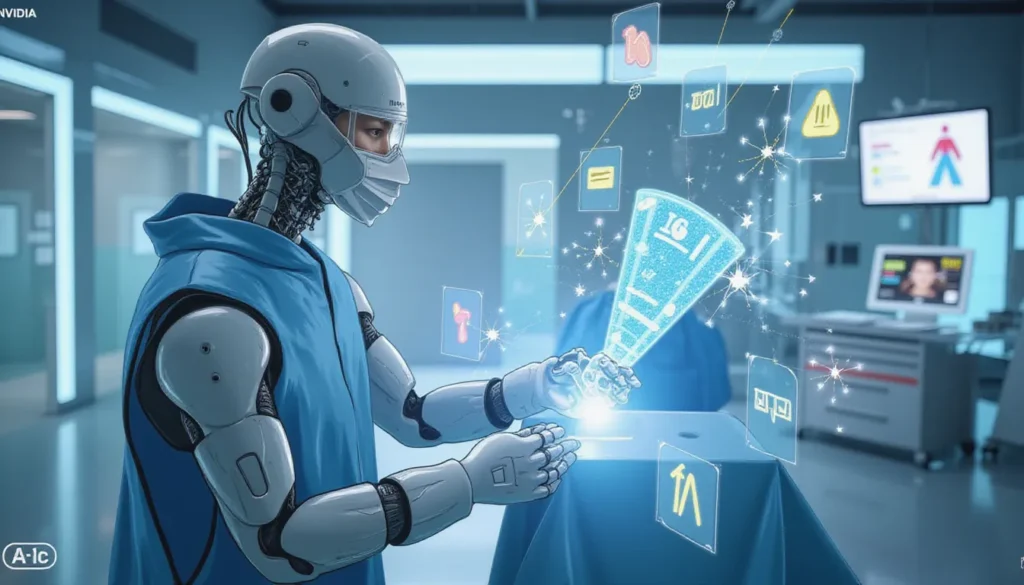
- 🧠 Sim2Real training can help surgical robots work almost as well in the real world, up to 92% accuracy, after learning in simulations.
- 💊 Simulation environments greatly reduce the need for physical data, reducing real-world training by over 85%.
- ⚡ GPU-based simulations train 3 times faster than CPU systems, making AI development quicker.
- 🚀 Open-source tools like LeRobot let smaller developers make good surgical AI models without high costs.
- ⚠️ But problems like the "reality gap" and the need for expensive equipment still stop many from using this in hospitals.
Healthcare Robots: Is Sim2Real Training the Future?
More healthcare robots are changing how medical work is done. They bring new levels of accuracy, steady work, and automation. Surgical robots used to be only in labs, but now they are in operating rooms. There, they help with hard surgeries, cut down on human mistakes, and make patients better. But turning these robots from lab tests into safe, dependable surgical helpers takes hard, costly training. This is where Sim2Real (simulation-to-reality) training helps. It is a strong way to train surgical robots in a virtual space before using them in real operations. This way of training could become a key part of how modern healthcare uses automation.
What is Sim2Real Training in Robotics?
Sim2Real (short for simulation-to-reality) is a way to teach robots using machine learning. It trains them in fake settings before they do real jobs. This means teaching AI what to do inside very good, physics-accurate fake situations that look like real ones. When the AI model learns well through watched and repeated situations, it is put onto a real robot to work.
Sim2Real is not just for healthcare, but it works very well for jobs that need great accuracy and have big risks, like surgery. In hospitals, even a tiny mistake can cause problems or hurt someone. Sim2Real training makes things much safer.
Here are the main benefits of Sim2Real in healthcare robots:
- Safe learning: Mistakes only happen in the fake system.
- Train many robots at once: Many robots can learn at the same time, making it much faster.
- Automatic checks: Fake cameras and sensors watch what happens. This lets us know right away how well the robot is doing.
- Repeat for free: Situations can be done again thousands of times without spending money on materials.
Good fake setups now copy real surgeries. They include real-looking human tissue, complex organ shapes, touch feedback, and camera views from inside the body. These features help robot arms and AI tools learn how to move and decide things before they go into a real operating room.
Use Case: Autonomous Surgical Robots
Robots that work on their own are made to do or help with jobs like stitching, burning tissue, cutting, and taking tissue samples. These jobs need careful, gentle work with soft body parts. So, there is little room for mistakes, and the risks are big.
Before, human surgeons ran these robots remotely. They used joysticks, pedals, and feedback systems to control the tools by hand. This worked well, but it is hard to use for many robots. And it depends on if a human operator is free and not tired. As surgical systems do more on their own, we must use AI to control them.
But getting enough real data to safely train self-operating surgical robots is not practical:
- Cost: It costs a lot to use operating rooms for training, and they are not always free.
- Ethics: Training on real patients would not be safe.
- Time: Getting data labeled by humans can take years for rare or hard surgeries.
This is where Sim2Real gives a big help. Using medical scans like MRI and CT, developers can make fake body parts that look just like a patient's. Then, these fake body parts are put into fake setups based on physics. These setups include bendable materials, how organs move inside, and even fake camera noise.
In these fake setups, robots learn to:
- Find important body parts.
- Stay away from blood vessels and nerves when cutting.
- Stitch accurately without pulling the tissue too much.
Zhang et al. (2020) showed that these ways of controlling robots could work with 92% accuracy when moving from fake to real laparoscopic tools. This shows Sim2Real's big ability to give safe, self-operating surgical help.
Anatomy of a Simulation-Trained Healthcare Robot
A surgical robot trained with Sim2Real goes through a careful process, from getting data to being put into use. Here are the steps:
Phase 1: Teleoperation and Baseline Collection
First, surgeons control a robot system from a distance. This human-led work gives important data. This data includes:
- Real-time camera feeds.
- Force sensor outputs from the robot’s grippers.
- Exact robot commands.
- Paths the tools take.
This data is the first "gold standard." AI models are trained and checked against it.
Phase 2: Simulated Data Generation
Developers use tools like NVIDIA Isaac Sim to make fake settings with lots of body parts. These settings look very much like real operating rooms. They include things like:
- Different amounts of tissue stretchiness and rub.
- Real-looking light and shadows inside body spaces.
- Fake patient movement from breathing or heartbeats.
Fake setups are made as different as possible. This is done with domain randomization, a method that adds small changes to get the robot ready for the real world, which can be full of surprises.
Phase 3: AI Model Training
New ways to train healthcare robots include:
- Imitation Learning: It copies how a human operator acts, using something called behavior cloning.
- Reinforcement Learning: It uses rewards and punishments to let the robot find the best ways to do surgery.
- Self-supervised learning: It helps the robot get better by learning from fake mistakes, without needing outside help to label things.
Training these models when not in use means no risk to patients and quick changes. At this point, AI agents practice thousands of fake surgeries, from simple cuts to hard knot-tying.
Phase 4: Optimization and On-Hardware Deployment
When the AI model works well enough, it is made better using tools like TensorRT. This is a fast engine that makes neural networks think quicker.
Finally, the model is put onto surgical robots that use edge computing systems like NVIDIA Jetson Orin. These are made to do calculations right away in demanding places like surgery.
Ecosystem Architecture: The Sim2Real Development Stack
To build a strong healthcare robot system with Sim2Real, you need many parts that work together. Here are the main tech parts:
-
Simulation Engines: NVIDIA Isaac Sim handles good graphics and physics in fake setups. These copy how tissues act, how light works, and how tools move.
-
Middleware: ROS2 (Robot Operating System) makes sure all parts talk the same way. This includes the robot's sensors, controls, movers, and screens. This helps build the system in parts.
-
Edge Compute Platforms: Devices like Jetson Orin give the computing power needed for tasks like splitting images, tracking objects, and planning movement during real surgeries.
-
Perception Libraries: Isaac ROS GEMs do tasks right away. These include seeing in 3D, sorting parts of images, figuring out where to grab, and making 3D models. All these are key for the robot to "see" during surgery.
All these parts together make a full system. This system guides robots from fake situations to helping in real surgeries with knowledge of the real world.
Building a Collect → Train → Deploy Pipeline
A clear set of steps helps make the Sim2Real process in healthcare robots standard and bigger:
1. Simulate
- Make hundreds of fake surgery scenes with different body part arrangements.
- Add difficult conditions, like blurry motion, blocked light, or liquid getting in the way.
2. Collect
- Use fake scenes to automatically record camera data, depth pictures, touch points, and tool spots.
- Add noise and compression problems to the data so it looks like what real sensors would pick up.
3. Train
- Use supervised or reinforcement learning programs. These programs have checks along the way.
- Make reward rules automatic. These rules are based on how well the surgery goes, like how tight a knot is, how close it is to nerves, or if bleeding is stopped.
4. Evaluate
- Use test systems and fake hospital setups to check how accurate, fast, and error-free the robot is.
- Adjust models using domain adaptation methods to make the Sim2Real gap smaller.
Once done, trained models are put onto real hardware. They are tested in controlled settings using fake tissues or robot test dummies.
Key Advantages of Sim2Real for Healthcare Robotics
Sim2Real brings very big benefits to many parts of healthcare robots:
- Can be used widely: AI rules can be trained on one system and put into many. This allows for quick updates across hospital systems.
- No patient risk: Fake setups lessen worries about early mistakes.
- Handles rare cases: Fake setups can show rare problems or patient issues that cannot be found with real data.
- Quick feedback: Development times get shorter, allowing for fast updates and better features.
Kruse et al. (2021) showed that in one use, training for hard-contact surgeries with fake setups cut the need for real data by 85%. This greatly speeds up how fast robots can be used.
Challenges and Barriers to Adoption
Sim2Real can do a lot, but using it more in healthcare has some problems:
- Reality Gap: Fake tissue might not fully act like real body parts, such as how stretchy it is, if it swells, or tiny bleeds.
- Sensor problems: Real tools add noise, delays, and changes in measurements. Fake setups cannot always guess these.
- Official approval: Groups like the FDA need proof from real hospitals. This means Sim2Real data still has to show it works in the real world.
- Cost and skills: The first cost for fake setup tools and training can be too high for smaller teams or hospitals.
Work is ongoing to make these gaps smaller. This uses mixed-reality settings, better physics models, and data from real patients.
Role of Open-Source Frameworks in Driving Innovation
Open-source tools are making it easier to start in medical robotics. One good example is LeRobot, a full Sim2Real research tool made for healthcare uses. It has these features:
- Complete surgical data sets (
lerobotdataset:v3.0) ready to be used for training. - Models that can be moved and work easily with other robotic arms.
- Fake setup settings that can be changed quickly to test new surgical jobs.
These tools are helping new ideas grow in universities, startups, and public hospitals. They give important parts needed to make, train, and use surgical AI. And they do this without needing special permits.
Surgical Assistance as an Automation Paradigm
Sim2Real is not just for fully self-operating surgery. It is also used for systems that help human surgeons or work as remote-controlled units in healthcare from a distance.
For example:
- Guided Robotic Surgery: Robots do jobs like pulling back tissue or suction on their own. This lets the surgeon focus on other things.
- Telesurgery: Sim2Real-trained robots work with someone watching from afar in country areas or places that need more care.
- AI Copilots: Help given right away, tracking tools, and warning messages make surgeries safer and more consistent.
As these systems get smarter, we might soon see operating rooms where AI and humans work together. Machines would help, watch, and even fix human mistakes right away.
How Entrepreneurs and Startups Can Get Started
There is a big chance for new ideas in healthcare robots. Sim2Real gives startups an affordable way to begin. Here is how to begin:
- First, fake it: Use Isaac Sim to make models of your specific surgeries, from belly surgeries to putting in bone screws.
- Use open data: Train with data sets that anyone can use, like LeRobot’s. This helps you get a first version ready faster.
- Test in fake setups: Use scripts to fake hundreds of surgeries before using real robot parts.
- Start small: Begin with just one Jetson-powered robot in a test area.
- Watch closely: Use tools like Bot-Engine to gather health numbers, records, video, and reasons for AI decisions when the robot is working.
This step-by-step plan lets you focus on new ideas instead of on setting up equipment.
The Future of Sim2Real in Precision Healthcare
Sim2Real will change how surgical robots learn. It will also change how hospitals use AI and robots in all parts of patient care.
New areas of use are:
- Digital Twins: Sim2Real models could make exact copies of patients. These could be used for planning and practicing.
- Early FDA Tests with Fake Setups: Recording fake setup results along with real-world use to speed up approvals.
- Crisis Prep: Train AI robots using fake injury or sickness situations for use in emergencies.
In the end, as fake setups get more real and ways to check them in hospitals get better, Sim2Real could become the main way to approve healthcare robots. This would cut years off the time to get them into clinics. And it would open up safer care for everyone.
Turn fake setups into real changes. With Isaac Sim, LeRobot, and tools like Make.com and Bot-Engine, your work with healthcare robots is just one fake setup away.
See how Bot-Engine can help put AI ideas into your healthcare work, without writing any code.
References
Kruse, T., Kim, B., & Grbic, M. (2021). Data generation in simulation for learning precise contact-rich surgical tasks. NVIDIA GPU Technology Conference.
https://developer.nvidia.com/blog/data-generation-in-simulation-for-contact-rich-surgical-tasks/
Zhang, T., Trescak, T., & Rye, D. C. (2020). Bridging the Sim2Real gap for surgical robotic learning. IEEE/RSJ International Conference on Intelligent Robots and Systems (IROS).
https://ieeexplore.ieee.org/document/9341264
Li, J., et al. (2019). Real-time surgical automation using GPU-accelerated training simulations. Advances in Medical Robotics.
https://dl.acm.org/doi/10.1145/3341105.3373836